Welcome to “Pills of Technique”. In the previous post we learned how to build a dipole. Now, it’s time to talk about the “bridge” that connects your radio to the antenna: the Balun.
1. What is a Balun?
The name is a contraction of BALanced to UNbalanced.
- Balanced: Your dipole is a balanced antenna (two identical halves).
- Unbalanced: Your coaxial cable is unbalanced (the center conductor is protected by the shield).

2. Why do you need it?
If you connect a coaxial cable directly to a dipole, the RF current starts flowing on the outside of the cable shield. This is called Common Mode Current.
The consequences are:
- RF in the Shack: Your radio, microphone, or even your mouse might behave strangely during transmission.
- Noise: The cable starts acting like an antenna, picking up interference from LED lights, PCs, and appliances in your house.
- Distorted Signal: The radiation pattern of your antenna changes, and it won’t perform as calculated.
3. The “Ugly Balun” (Air-Core Choke)
The simplest way to stop these unwanted currents is to create an Ugly Balun. It is called “ugly” because it’s just a coil of coaxial cable, but it works great for a single band!
How to make it:
- Take a PVC pipe (diameter about 10-15 cm).
- Wind about 4-6 meters of your coaxial cable (RG-58 or RG-213) around the pipe.
- Secure the turns with cable ties or tape.
- Place it right at the antenna feed point.

4. Deepening and Technical Resources
If you want to understand the physics behind this or see professional measurements, I highly recommend these resources:
- IZ2UUF – Balun 1:1: come farlo e perché: An excellent and deep technical analysis (in Italian) about why we need Baluns and how they work.
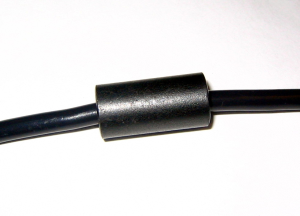
- VK6YSF – 1:1 Choke Balun: Practical examples of Baluns made with ferrite cores.
- Wikipedia – Balun Concepts: For a general overview of the different types (Voltage vs Current baluns).
Pro Tip: If you are using a multi-band antenna or an ATU (Antenna Tuner), a Balun is even more important to keep the SWR stable and avoid “hot” metal chassis in your station!
Enjoy your DIY experiments!
If you have questions or want to suggest the next “Pill”, write me a comment!
1 thought on ““Pills of Technique”: The Balun – The Bridge for your Antenna”
Comments are closed.