You have your antenna, your cable, and your radio. You press the PTT and… you talk to someone 3,000 km away! How is this possible? The secret is the Ionosphere.
1. The Earth’s Mirror
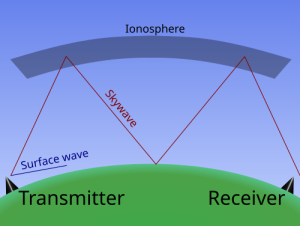
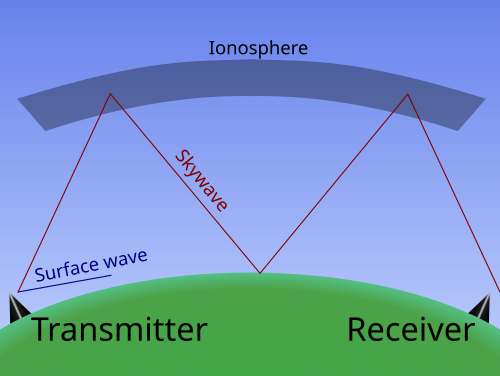
The Ionosphere is a region of the upper atmosphere (from about 60 km to 400 km high) that is “ionized” by solar radiation. For HF radio waves, it acts like a giant mirror in the sky.
- The Bounce: Your signal goes up (Skip), hits the ionosphere, and “refracts” back to Earth far beyond the horizon.
2. Day vs. Night
The Ionosphere changes depending on the sun:
- Daytime: Higher frequencies (like 10, 15, and 20 meters) work best because the sun makes the layers dense and reflective.
- Nighttime: The lower layers disappear. Lower frequencies (like 40 and 80 meters) become the “kings” of the night for long distances.
3. The Solar Cycle
The Sun has an 11-year cycle. During the “Solar Maximum” (lots of sunspots), even a small antenna can reach the other side of the world on 10 meters. During the “Solar Minimum”, the higher bands might feel “dead”.
4. Deepening and Technical Resources
- SpaceWeather.com: To monitor sunspots and solar flares in real-time.
- VOACAP Online: A professional-grade (but easy to use) propagation prediction tool.
- Solar Terrestrial Data (Ham QSL): The famous “colored boxes” you see on many ham websites explaining band conditions.
Pro Tip: If you hear “noise” but no voices, the band might not be closed! Check FT8 frequencies or beacons to see if signals are actually passing through.
Next Step: Is your backyard too small for a horizontal dipole? In the next pill, we’ll see how to go “vertical” with Ground Plane antennas and why the ground under your feet is so important!