Do you have a small balcony or a “no-antenna” policy in your building? Don’t give up on HF! The Magnetic Loop (or Small Transmitting Loop) is a compact solution that defies common sense: it’s small, but it works surprisingly well.
1. What is a Magnetic Loop?
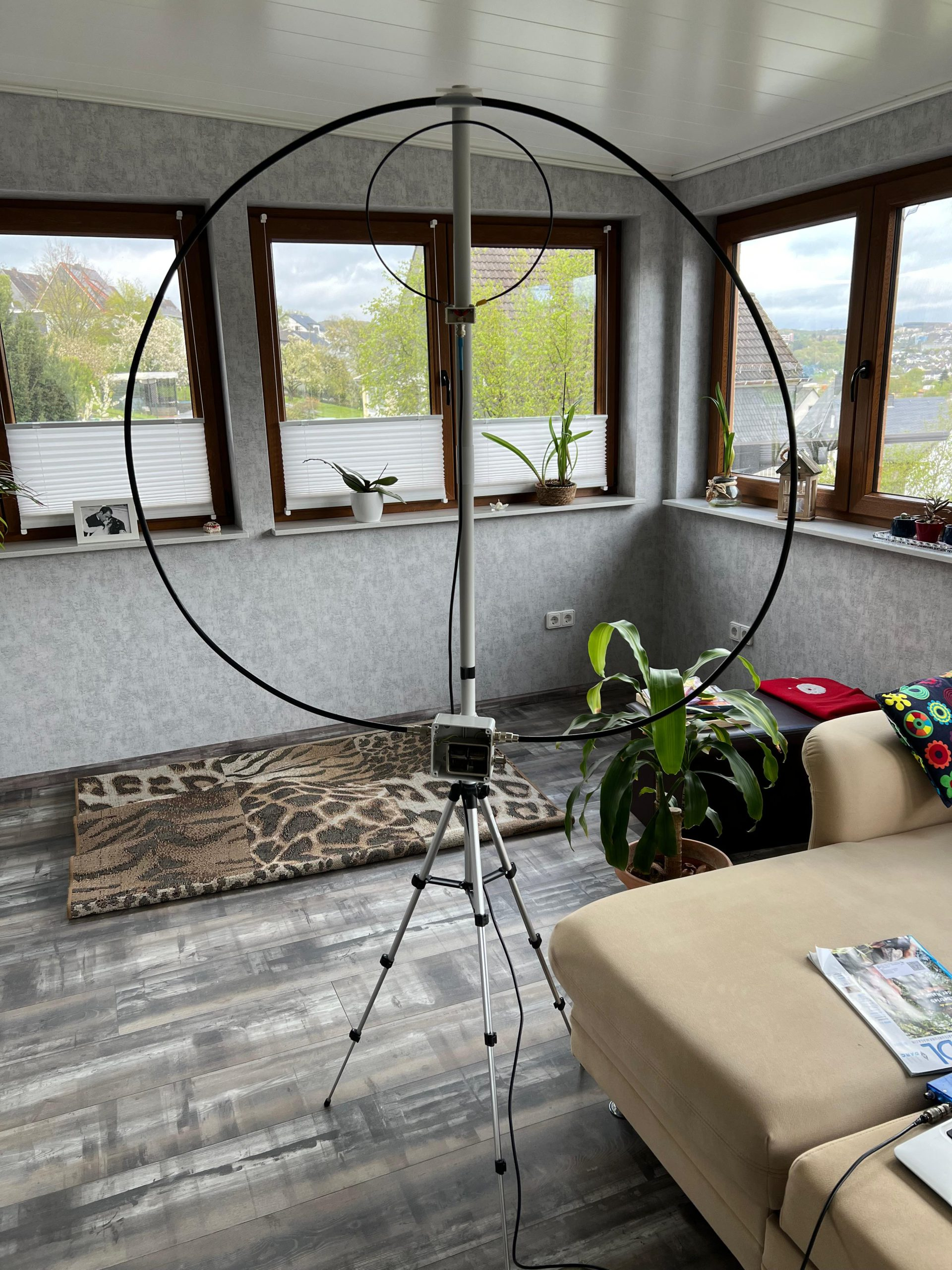
A Magnetic Loop is a ring of thick conductor (copper pipe, aluminum, or even thick coax) with a circumference usually less than 1/4 wavelength. Unlike standard antennas, it interacts primarily with the magnetic field of the radio wave.
- The Big Loop: The main antenna.
- The Small Loop: A smaller ring (1/5 the size of the big one) used to “inject” the signal (the feedlink).
- The Capacitor: A variable capacitor used to “tune” the antenna to the exact frequency.
2. Why is it special?
- High Q (Selective): It acts like a very sharp filter. It reduces noise from nearby electronics and only “listens” to a very narrow frequency.
- Compact: A loop for 20 meters is only about 1 meter in diameter!
- No Ground Needed: Unlike vertical antennas, it doesn’t need radials to work.
3. The “Danger” and the Challenge
- High Voltage: Even with only 10 Watts, the voltage across the capacitor can reach thousands of Volts! Never touch the antenna while transmitting.
- Sharp Tuning: Since the antenna is very selective, you need to retune the capacitor every time you move even a few kHz on your radio.
4. Deepening and Technical Resources
- 66 Pacific – Magnetic Loop Calculator: Enter your diameter and power to see the required capacitor value and the expected efficiency.
- Steve Yates AA5TB – Small Transmitting Loop: One of the most famous and detailed websites about loop theory and practice.
- DK6MAX – My Korean Loop: Check out my own DIY project and see how a magnetic loop looks in real life!
Pro Tip: Because the Magnetic Loop is so sharp (High Q) and bidirectional, you can use it to “null out” a local source of interference. Just rotate the antenna until the noise disappears – it works like a charm!
Next Step: Now that we’ve explored the “small” world, let’s go back to the ground. In the next pill, we will talk about Ground-Mounted Verticals and Buried Radials: the best way to be “invisible” in your garden!