Why do we use dB instead of just Watts or Volts? Because in radio, we deal with enormous differences. A signal from a distant satellite might be billions of times weaker than your transmitter. The Decibel (dB) makes these numbers easy to handle.
1. What is a Decibel?
A decibel isn’t a fixed unit like a “Meter”; it’s a ratio. It tells you how much a signal has increased (Gain) or decreased (Loss) compared to a starting point.
2. The “Rule of 3” and the “Rule of 10”
You don’t need a scientific calculator to understand the basics. Just remember these two simple rules:
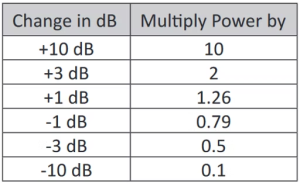
- +3 dB = You doubled your power (e.g., from 50W to 100W).
- -3 dB = You halved your power (e.g., from 100W to 50W).
- +10 dB = Your power increased by 10 times (e.g., from 10W to 100W).
- -10 dB = Your power decreased to 1/10th (e.g., from 100W to 10W).
3. dBd vs. dBi: Don’t be fooled!
When you buy an antenna, look at the gain units:
- dBd: Gain compared to a Dipole. (Real-world reference).
- dBi: Gain compared to an Isotropic radiator (a theoretical point in space).
- The Trick: An antenna with “5 dBi” sounds better than “2.85 dBd,” but they are exactly the same! Just subtract 2.15 from the dBi value to get the real dBd gain.
4. Deepening and Technical Resources
- Wikipedia – Decibel: For a deep dive into the logarithmic math behind the ratio.
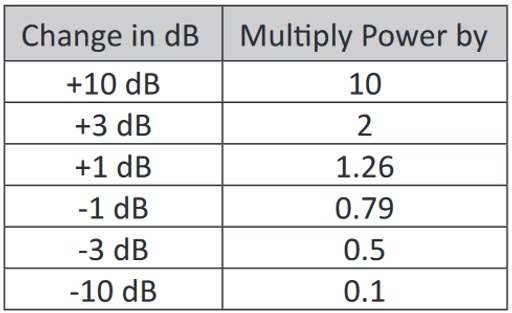
- Electronics Notes – dB Power Table: A handy reference table to quickly convert dB to power ratios.
- Online dB Calculator: A simple tool to calculate gain and loss for your station.
Pro Tip: Your S-meter on the radio is calibrated (usually) so that one S-unit equals 6 dB. This means that to move your friend’s S-meter from S-8 to S-9, you need to increase your power by 4 times (3dB + 3dB)!